
Steel Series
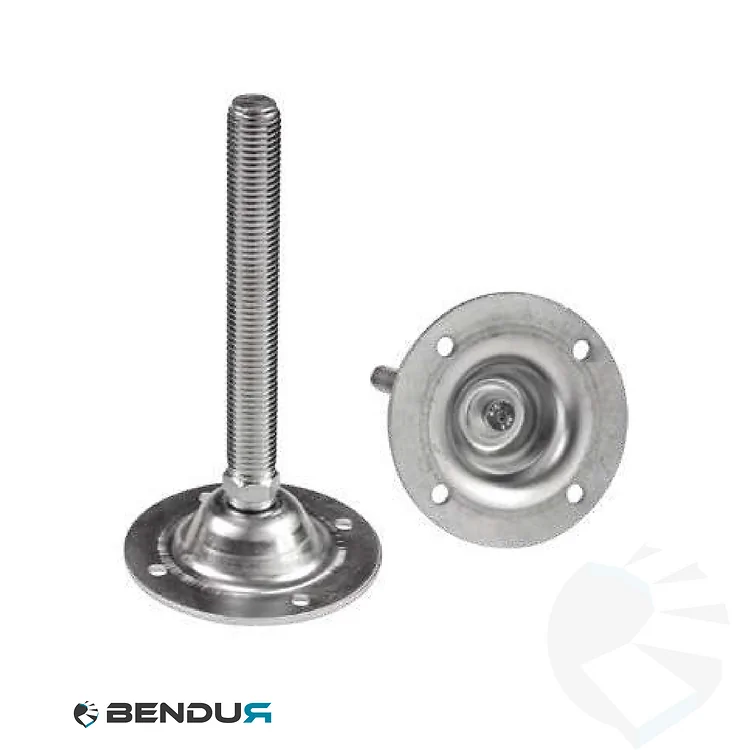
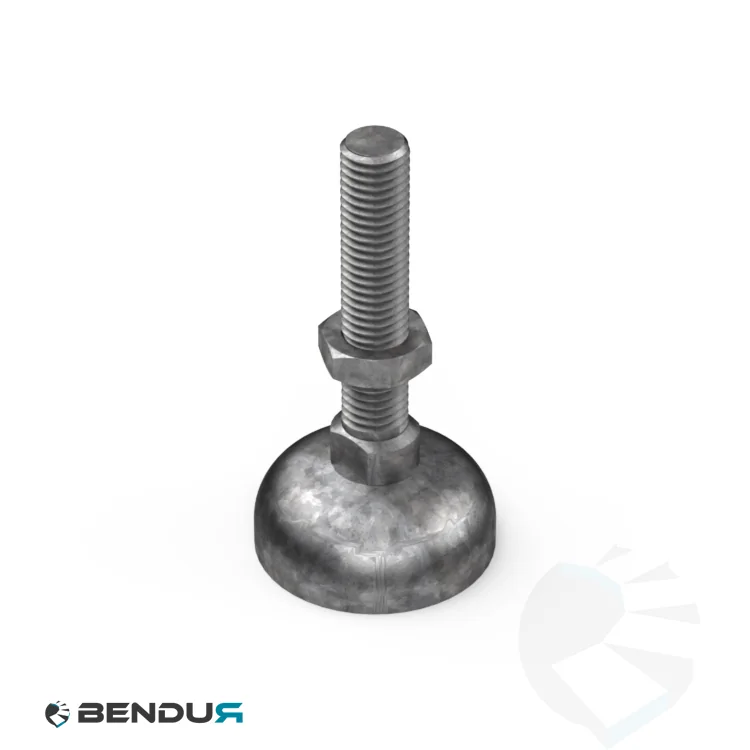
The Steel series has a steel foot: a stamped foot Ø123.5, according to the product description ideal for heavy and dirty production environments, or a domed foot of galvanised steel for slightly uneven floors. Choose your version and foot diameter:
-
Having trouble choosing between our products?
With our help, you will easily find the right product.
Contact us
Choosing a steel levelling foot, Steel: foot diameter, thread and load capacity
Choose the version and the foot diameter. Take a load capacity well above the load per foot: add up the weight of the machine and the load and divide by the number of feet.
Steel with stamped foot Ø123.5
Ø123.5, M16, M20, M24 or M30, 10,000 N per foot.
| Foot | Thread | Total height | Max. load capacity |
|---|---|---|---|
| Ø123.5 without floor mounting | M16, M20, M24 or M30 | 155–230 mm | 10.000 N |
| Ø123.5 with floor mounting, two holes | M16, M20, M24 or M30 | 155–230 mm | 10.000 N |
| Ø123.5 with floor mounting, three holes | M16, M20, M24 or M30 | 155–230 mm | 10.000 N |
Steel with domed foot of galvanised steel
Ø45–90 mm, M12 or M16.
| Foot | Thread | Total height | Max. load capacity |
|---|---|---|---|
| Domed foot Ø45 | M12 or M16 | 85–160 mm | – |
| Domed foot Ø60 | M12 | 88 mm | – |
| Domed foot Ø90 | M16 | 85–200 mm | – |
Total height and maximum load capacity per foot according to the product description; the load capacity depends on the thread. 10,000 N is about 1,000 kg. On the product page you choose the thread and the length of the spindle.
What is the Steel?
- Foot. Stamped foot Ø123.5, without or with floor mounting; or a domed foot of galvanised steel, Ø45, 60 or 90.
- Spindle. Fully threaded spindle. With the stamped foot you choose stainless steel or galvanised steel; the domed foot has a galvanised spindle and comes with a nut DIN 439 (ISO 4035).
- Who it is for. According to the product description: the stamped foot for heavy and dirty production environments, where a low hygiene level and a low load are required; the domed foot for slightly uneven floors, and suitable for ESD (electrostatic discharge).
Levelling foot M12 in an aluminium profile
The Steel comes in M12, M16, M20, M24 or M30. This is how you fit it under a frame of aluminium profiles:
- M12 in the core bore. A BSB profile with slot 10, such as 40x40L or 45x45, has tap size M12. If you order the profile cut to length, have the core bore tapped: you screw a levelling foot with M12 straight into it. See the BSB 40 series.
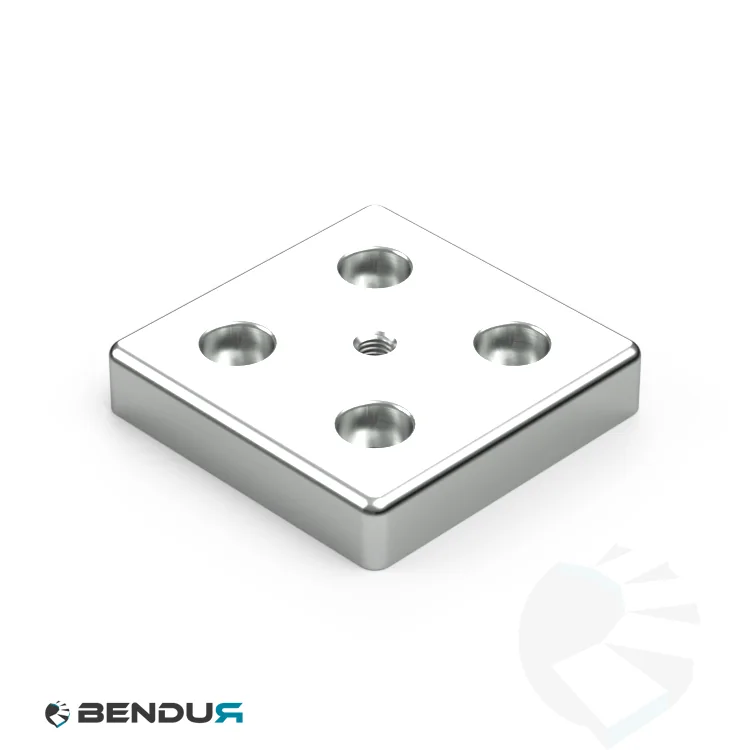
- M12, M16 or M20 in a foot plate. You screw a transport and foot plate onto the end of the profile; you choose the threaded hole in the middle from M8 to M16 or M20, depending on the plate. Choose the threaded hole that matches the thread of your levelling foot. That way the levelling foot also fits under a profile with a smaller tap size, or with two or four core bores.
- M24 and larger. There is no foot plate and no tap size in an aluminium profile for that: this thread is for a frame or machine with its own threaded hole of that size.
Not sure which profile system you have? Ask us.
What do you need with a Steel levelling foot?
What you add depends on where the levelling foot goes.
Frequently asked questions about the Steel levelling foot
Your question not here? Email us and we will help you think it through.
How much can a Steel levelling foot carry?
According to the product description, the maximum load capacity is 10,000 N per foot; 10,000 N is about 1,000 kg.
Which thread sizes does the Steel have?
M12, M16, M20, M24 or M30. The table shows which thread you can choose for each foot diameter; you choose the spindle length on the product page.
Does a Steel levelling foot fit in an aluminium profile?
Yes. A BSB profile with slot 10 has tap size M12: choose a levelling foot with M12 and have the core bore tapped. If your profile has a different tap size, use a transport and foot plate on the profile end.
What does "+ fg" mean?
"+ fg" means with floor mounting: you fix the foot to the floor.
Which levelling foot do I use on an uneven floor?
The domed foot: according to the product description, for use on slightly uneven floors. It is also suitable for ESD.
What is the difference between the two stamped feet with floor mounting?
In the drawing, one has two holes and the other three holes to fix the foot to the floor. Thread, height and load capacity are the same.
Not sure which Steel fits?
Email us the weight of your machine or frame, the number of feet and the thread. We will find the right levelling foot for you.